1Sat Ordinal ticketing · physical and virtual events
Secure at the gate. Valuable after the show.
With TicketMint, each ticket is a single satoshi on the BSV blockchain: issued by the organiser and checked at the gate by a key signature instead of a barcode. After the show it remains a collectible, tied to its original on-chain artwork.
How it works
Three checks stand between a fake and the door.
A barcode is a picture, and pictures copy. A TicketMint ticket is an on-chain asset held by a key, so a gate can ask questions that a copy cannot answer.
Issued by the organiser
Every ticket names its issuer and is minted in a public transaction. A ticket that does not trace back to the organiser's own mint fails the gate's check.
Signed by the holder's key
At the door, the gate shows a fresh one-time challenge and the holder's key signs it. A screenshot or a forwarded QR code has no key, so it cannot answer.
Admitted once
The gate turns away a ticket it has already admitted.
Plain answers
What the blockchain guarantees, and what it leaves to the gate.
“On the blockchain” is often used to mean more than it does. Here is the line between what the network enforces for everyone and what the issuer and the venue remain responsible for.
Enforced by the network
- No double spend. Each transaction output can be spent only once, so the same ticket cannot be sent to two people. No issuer, venue or platform, including us, can make the network accept a second spend.
- A permanent, public origin. The transaction that created the ticket, and the artwork inscribed in it, stay on the public chain. A ticket that changes hands is traced back to that origin.
- Verification without permission. Anyone with a public explorer or indexer can check where a ticket came from and where it is now, without an account and without asking TicketMint.
Checked by the gate and the issuer
- Admission. The chain shows which key holds a ticket; it does not open a door. The gate checks the holder's signature and whether it has already admitted that ticket.
- How many tickets exist. The issuer decides how many to mint. The chain does not cap supply; it makes each mint visible.
- Offline doors. When venue connectivity drops, gates verify against a list synced before doors open and reconcile afterwards. Two disconnected gates can briefly both admit the same ticket; syncing closes that window and flags the collision.
Who it is for
Simple for fans. Useful for the people running the night.
For fans
- A ticket you can check. Its origin and its current holder are public, so a buyer can check a ticket's origin against the organiser's own record and see that the seller still holds it before money changes hands. Whether its admission is still good is the organiser's record, not the chain's.
- Nothing to learn. The goal is “log in, here is your ticket” — the wallet is created for you and the blockchain stays out of the way.
- Something to keep. After the show the ticket is designed to stay with you as a collectible, linked to its original artwork, as a record that you were there.
For organisers and artists
- Your name on every ticket, and by design your signature. Tickets are designed to be issued under your identity, not ours, so authenticity does not depend on a reseller's word.
- Gates built for real venues. The gate protocol covers both online and offline scanning, with duplicates detected across gates.
- One system for doors and streams. The same ticket and the same signed check are designed to open a venue door, a stream or a VIP room.
Events
One kind of ticket for physical, virtual and hybrid events.
Every ticket is the same primitive, a one-satoshi ordinal with artwork and event details, configured for the event it belongs to.
Concerts and club nights
General admission or reserved, with a collectible that outlasts the night.
Festivals
Several tiers and several gates, including gates that lose their connection.
Streams and virtual events
The signed check that opens a door is designed to unlock a stream as well.
VIP and backstage
Tiered access from the same ticket, so one pass can cover the venue and the room behind it.
See for yourself
A real ticket, on mainnet, that you can check without us.
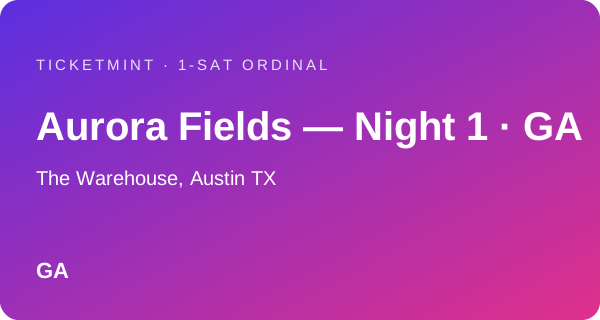
We minted this demonstration ticket on 8 July 2026. It is one satoshi, it has not been spent, and every fact below comes from the public chain. It is held under a plain single-key lock. Its embedded details follow an earlier format, including a resale-policy label that nothing enforces.
- Ticket (outpoint)
- 287f2cfdf7cb32a36eac063b43c9996d18de5235600dc35dd858299deb9f18b9_0
- Value
- 1 satoshi
- Block
- 956,965
- Artwork
- image/svg+xml, 824 bytes
- Artwork SHA-256
- 7b5f8e1df730339f96b90a6dc80f274ff2a02f7a31cc50803fb9be331f6a9af2
Get in touch
Planning an event? Tell us about it.
We would like to hear from organisers, artists and venues who want to run an event on TicketMint, in person or streamed.
hello@ticketmint.app